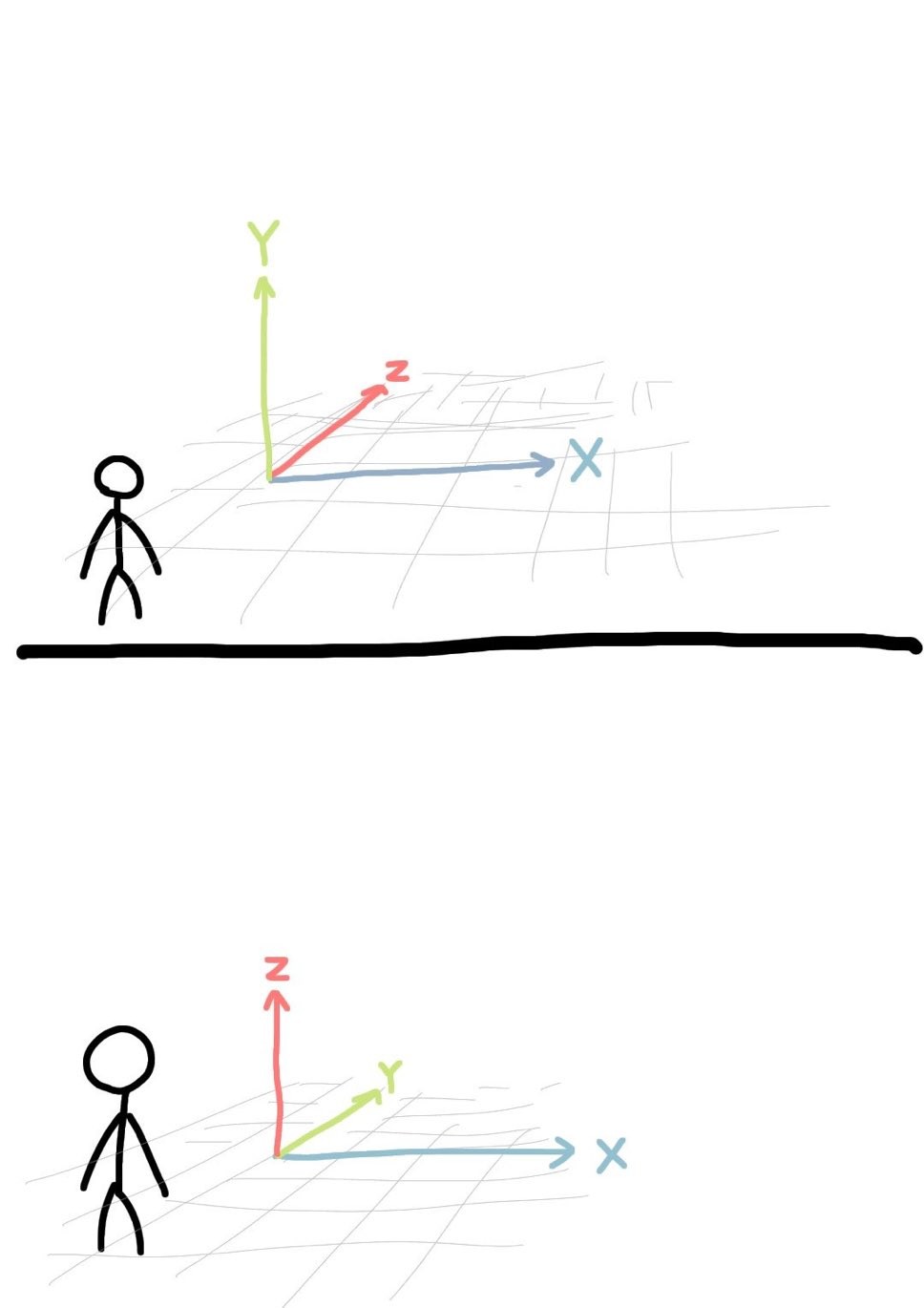

Z is elevation. Any real world application, z goes up down. 3D applications SHOULD use it for elevation. I despise that many do not. It’s so fucking confusing. 2D, sure y go brrr. But once that 3rd dimension is added, y needs to take several seats and quit trying to take on dimensions it doesn’t have any right to.
Y-up sorta makes sense in games. Imagine a 2D platformer, Y is up and X is horizontal. Now add depth. Instead of flipping axis just use Z for depth.
But in top down 2D games you also use X and Y but now neither is up
True but I think it’s also because of screen coordinates, Y is always the vertical axis in screen coordinates. So programmers translated that to 3D coordinates because in real world space the screen doesn’t lie flat but is up right. It’s probably why Y is up in OpenGL and calls the depth buffer the Z-Buffer.
That’s the core of my point though. Once you add depth it’s not 2d space anymore (even though the screen is 2d, the represented field is 3D) and y becomes depth.
It all depends how you perceive the XY plane. Like if your job involves blueprints than XY plane lies flat and horizontal then it makes sense that Z axis is height. Hence why engineering software is all Z-Up. If the XY plane is upright, like screen coordinates, then Z is depth. Hence why many software that is used to create content for the screen is Y-Up. Like Maya, Houdini, Unity, OpenGL etc.
It makes more sense if you’ve ever drawn in CAD. Top view, x and y. Now side view, y and z or y and x. You look down on x and y, and if you are extruding you now create the z axis dimensions. For the people who draft on the side axis: you are true psychos (ok, unless you’re using a lathe I suppose, or if the silhouette is more defined from the side… ok maybe not psycho, just odd)
User look sideways at item on shelf. Designers look down on paper. Both viewpoints are needed for it to be a good object.
Architects do both because they have all that math and something serious to prove.
I do use CAD software but always have my items resting on an x/y plane with z being height. I do some 3d printing and basic cad designs, so z being elevation still makes sense there.
You convinced me. Have an internet point.
Lol I was just ranting into the void but glad it resonated for you.
I’ll leave this here for context (bottom right is the only sane one)

Minecraft being the most influential of them all
The top one is wrong because it violates the right hand rule.
Z should be inverted in the top picture.
Agreed. That would be totally valid.
go home programmer, math does not need you!
What about the left hand rule?
Vector mathematics as we use it and code it is based on the right hand rule.
Giggety
No, there are 3 actually:

damn Australians
I use all of them depending on what the coordinates are representing…
X is up, there now no one is happy.
I’m came here to talk shit about y-up but now I’m mad at you instead.
I legit had no idea anybody actually used the upper system until now. I had to read the comments just to see whether the upper system was just some sort of joke. I am horrified.
It depends on how you view 2D->3D.
If you’re thinking of a side scroller like the original Super Mario, Y is up/down and X is left/right making the new dimention Z being forward/backward.
However if you think of 2D space like the first LoZ, then Y is North/South and X is East/West making Z up/down
Same with CSS for the same reason.
Almost the entirety of computer graphics uses the z coordinate for depth afaik.
Even Minecraft does it.
Yeah, and for a top-down game depth is up/down. You know, like depth being… Deep down.
As someone who looks at this from a GIS / cartographic view, the top option being possible is horrific to me.
Surely you mean the bottom one
https://help.autodesk.com/view/MAYAUL/2024/ENU/?guid=GUID-FDC58F4E-63B9-4012-B232-5F2FBAC5EAC9
Y-up and Z-up
In animation and visual effects, the tradition is to use Y as the “up” or elevation axis, with X and Z as the “ground” axes. However, some other industries traditionally use Z as the up axis and X and Y as the ground axes.
Z is depth, full stop, and I have my fists raised, Queensbury-style, to anyone who contends otherwise.
deleted by creator
Neither of these are right. X is forward, Y is to the right and Z is down.
Source: https://iansguides.com/tutorials/aircraft-coordinate-system-and-anatomy/
y-up ftw
It’s easier when writing 3d renderers cause the x and y coordinates of the 3d points eventually become the x and y coordinates of the 2d points on screen and it’s easier to keep track of
Except when you are working on top-down game/3D environment. In which case you are constantly changing between Z and Y…
Indeed, depth buffers etc are from the z coordinate.
Also on the web, the “z-index” is the depth of elements in the world of CSS.
I wonder in which contexts y would make more sense as the depth.
Isometric 3D top down games
Thanks to 3D printing Z is firmly “up” in my brain even if the modeler I use does it differently.
If 2d, Y up, if 3d Z up.
I always tough as inputs down, answer up. And usually, x is the variable y the result, or xy the variables and z the result
Oh. Agree, also use the same convention; my brain never made the connection f(i, j) goes up and i and j are inputs and stay down.
Yeah… As a Blender 3D artist, Z axis has been baked into my brain as the up/down axis.
“baked” pun intended maybe?
Always bake.
I’ve been making models in Blender to import into Godot so I have to constantly switch.
I have experienced this. It was pretty confusing at first.
Above and below the page/plane is the z-axis.
But some people “hold” the page up in front of them, or down on the table.
My “page” is my monitor’s screen, a window into many virtual worlds that extend past the plane of my screen.
Actually, my screen is a curved surface. So the 3d virtual world is projected onto a 2d plane which is then projected back onto a 3d curved screen. The math to make it look correct in the final projection is different from what makes it look correct on a flat screen, though I don’t know if any renderers actually do this correction. Not that I think the difference is huge.
In 2D Y is up, in 3D Z is up.
X is always red🤷♂️On Nintendo X is up. On Xbox X is left. On Playstation X is down.
Nintendo couldn’t even agree with themselves. On GameCube X is right.
I’m from a computer graphics background.
Y is down. z is depth. Fight me.
You’re on, just send the coords!
Wait why are you on the ISS?
In a 2D game Y is up. Going from 2D to 3D would make sense to add another dimension forward to account for depth.
However if you start with a map of a 3D surface then North is Y and East is X you’d add Z to account for elevation like everybody making maps would.
I guess it depends on how you look at it.
Yes, but please just make it follow the right hand rule…
Which one?

(Technically all the same, I know).
The first? I dont know… They all look weird since the finger axes dont intersect properly.
Z is always depth. Both are correct but define different perspectives. Top is looking across the landscape from an arbitrary floating perspective, bottom is looking down with anchored mapping to the surface.
yep. in 2 dimensions, nobody really debates on whether x or y should point up, so i kinda think the debate about z stems from whether one thinks we should put the xy plane horizontally (like a sheet of paper on a desk), or vertically (like a chalkboard).
does any software default to making x be the vertical axis?
Good answer. Many posts are people saying “my approach is the right one, other people are irredeemable morons who should burn in hell”, but you’re right, it depends on your perspective.
Smh I was fine with both. The upper one reminded me of the X Y axis we use to represent functions in maths. While the lower one represents altitude on a 3D map.
Invert y axis is the first option I tick in every game
Spent most my life working in a 3d environment… need to reverse that thing for a controller every single time